

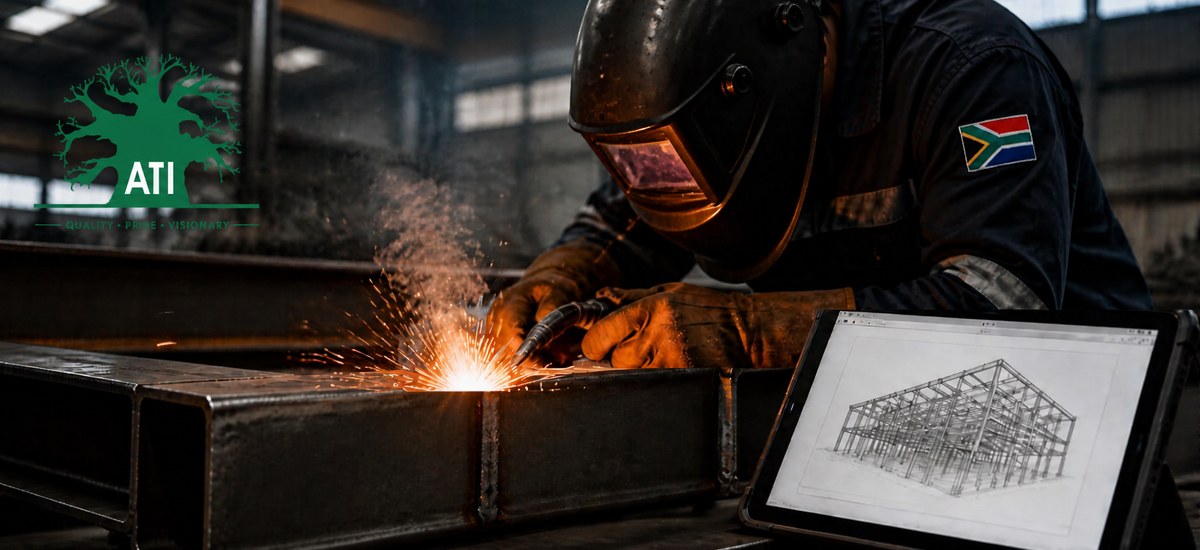
Everyone told you a desk job was the safe option. In the age of AI, some of the most AI-proof careers start in a workshop, not an office.
Career Development | By Artisan Training Institute
Here’s a question your career guidance teacher probably didn’t ask. What if the “safe” office job turns out to be the risky one?
For generations, parents pushed their children towards desks. Many people saw manual work as the fallback. However, artificial intelligence is turning that thinking upside down. AI can now draft reports, answer customer queries and crunch numbers in seconds. Yet it still can’t crawl under a haul truck and find an oil leak.
This isn’t a call to give up on university or office work. Instead, it’s a call to look harder at where AI-proof careers are really found. The answer may surprise you, and it may annoy a few people too.
What the Data Says About AI and Jobs
Let’s start with the facts, not the hype. The World Economic Forum’s Future of Jobs Report 2025 looked at how work will change by 2030. Its findings are worth reading slowly:
- The world will gain about 170 million jobs by 2030.
- About 92 million jobs will disappear.
- That leaves a net gain of roughly 78 million jobs.
- Experts expect about 39% of workers’ core skills to change.
So, AI isn’t simply destroying work. Instead, it’s moving work around. The real question is which jobs are on the losing side of that shift.
According to the same report, clerical roles should decline the most. Meanwhile, frontline roles such as construction workers are expected to grow in absolute terms. In other words, the jobs most exposed are often the ones families have long called “safe”.
That should make every school leaver, and every parent, stop and think.
What this means for desk jobs
To be fair, office work isn’t disappearing overnight. Many professionals will use AI to work faster rather than lose their jobs. However, entry-level desk roles are often the most repetitive, and repetitive tasks are the easiest to automate. If your plan is to start at the bottom of an office ladder, the bottom rungs may get thinner.
By contrast, an apprentice starts by learning physical, practical skills. Those skills take years to build, and that’s exactly what makes them hard to copy.
Why Hands-On Trades Are Among the Most AI-Proof Careers
Why are hands-on jobs harder to automate? Because the physical world is messy. AI is excellent at tasks that happen on a screen, follow clear patterns and use tidy data. By contrast, a broken pump on a mine at 2am isn’t tidy at all.
Think about what an artisan does in a day:
- Works on site, in tight spaces, at heights or underground.
- Diagnoses faults that don’t match the manual.
- Uses judgement about safety, risk and what to fix first.
- Adapts to old equipment, implements modifications and responds to changing conditions.
Each of those tasks needs a body, hands and experience in the same place at the same time. Software coupled with robotics can help with that work. However, it can’t yet replace the person holding the tools.
The South African angle
Locally, the need for quality-trained artisans is as real as ever. Electricians, welders and boilermakers, diesel and automotive mechanics, millwrights and fitters remain on the national lists of scarce and in-demand skills.
Also, the average age of South African artisans has been reported to be about 55, a figure that has been quoted for many years. In all probability, many experienced tradespeople have already retired, and many more will retire in the coming years. Someone will need to keep the mines, plants, power systems and fleets running. AI will not do it alone.
Meanwhile, youth unemployment sat at 47.4% in the second quarter of 2026. We have millions of young people looking for work, and an ageing workforce that needs replacing. That’s an opportunity hiding in plain sight.
The Catch: No Career Is 100% Future-Proof
Now for the honest part. We’d be misleading you if we said the trades are untouchable. No job is completely future-proof, including ours.
Also, remember that 39% figure. Skills are changing in every kind of work, not only in offices. A trade qualification is a strong foundation, but it isn’t a reason to stop learning. The artisans who keep upskilling will pull ahead of those who believe their qualification means they have arrived.
Here’s what’s changing: trades are going high-tech, fast. Modern diesel engines run on electronic control units. Factories use programmable logic controllers (PLCs) to run production lines. Instrumentation measures pressure, flow and temperature, then feeds that data to computer systems.
The artisan of 2030 won’t just be good with tools and equipment. They’ll also plug in a laptop, read fault codes and work alongside smart systems. In fact, the best artisans will likely use AI tools to diagnose problems faster (see www.artisan-life-pulse.com for the ALP-AI-App).
That means two things for you:
- An old-school artisan who refuses to learn new tech may struggle.
- A tech-literate artisan who can fix the machine and read its data will be in a very strong position.
In short, AI-proof careers aren’t about avoiding technology. They’re about doing the work technology can’t do on its own and using technology to do it better.
Which trades offer AI-proof careers?
If you enjoy both hands-on work and technology, look closely at these trades:
- Electrician: Every new system, from solar to automation, needs someone to wire it safely.
- Instrument Mechanician: You’ll work with the sensors and control systems that modern plants rely on.
- Diesel Mechanic: Heavy vehicles are packed with electronics, yet they still break down in the real world.
- Millwright: This trade combines mechanical and electrical skills, which makes it a natural fit for automated plants.
- Boilermaker: Fabrication and welding still need skilled hands-on site work.
How to Build One of the Most AI-Proof Careers Out There
So where do you start? First, choose a trade that matches your interests. Second, make sure you train with a properly accredited provider. Finally, commit to learning for life, because your trade will keep evolving.
At Artisan Training Institute (ATI), we’re a QCTO-accredited Skills Development Provider and Trade Test Centre, on the recommendation of NAMB. You can check any provider’s accreditation with the QCTO. We train over 2,000 apprentices a year for companies in South Africa and abroad.
Our trades include Electrician, Diesel Mechanic, Motor Mechanic, Boilermaker, Millwright and Instrument Mechanician. We also offer engineering qualifications and short courses. Our campuses are in Roodepoort, Kimberley, Kuruman and KwaZulu-Natal. Also, study loans are available through Capitec and Nedbank.
Still not sure? Ask yourself one simple question. Would you rather compete with AI, or be the person AI can’t replace? Plus, a trade qualification can open the door to work in the country of your choice. For many young South Africans, AI-proof careers start with a trade.
Parents, this matters for you too. The safest advice you can give your child today may not be the advice you received. Therefore, keep an open mind when they mention a workshop instead of a lecture hall.
Curious how AI and the trades work together? Artisan Life Pulse is another company in our group, and it integrates AI technology into the ALP-AI-App. Visit www.artisan-life-pulse.com to find out more.
If you’re weighing up your options and want a career that will still matter in 2030, let’s talk. Our team can help you choose the right trade, check entry requirements and plan how to fund your studies.
Get in touch with our team:
info@artisantraining.co.za | www.artisantraining.co.za | +27 (0)11 472 3443
Engineering better futures for everyone.