

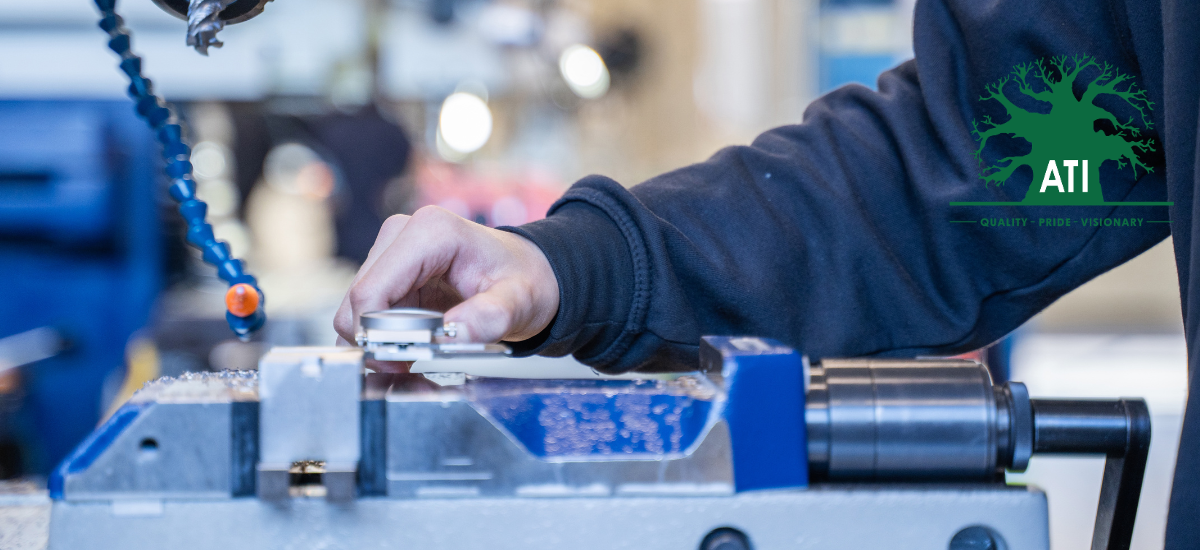
Love the idea of turning raw metal into precision parts? ATI’s QCTO-accredited apprenticeship is your route to a metal machinist career built on skill.
Career Development | By Artisan Training Institute
Maybe you’ve just finished matric and don’t know what’s next. Maybe you work as a general worker or assistant and know you’re capable of more. Or maybe you want a career where your skills are in demand and your work means something. If you enjoy working with your hands, solving problems and getting details right, a metal machinist career could change everything.
What does a Metal Machinist do?
Metal Machinists, sometimes called Turners, shape raw metal into precise, finished components. In addition, you’ll work on lathes, milling machines, grinders and CNC (Computer Numerical Control) equipment. You’ll also read engineering drawings and cut parts to tolerances finer than a human hair. For example, your parts could end up in a vehicle engine, a mining machine, a medical device or an aircraft. It’s work you can see, measure and be proud of.
Why an accredited apprenticeship starts your metal machinist career
An apprenticeship lets you learn the trade the way it’s really done. Moreover, you study theory in the classroom and gain hands-on time on the machines, side by side. As a result, you build real workshop skills from the start instead of studying for years before you touch a lathe. Meanwhile, you work towards your trade test and the Red Seal qualification that marks you as a fully qualified artisan.
Accreditation matters, because not every course leads to a qualification employers recognise. However, the QCTO (Quality Council for Trades and Occupations) accredits ATI’s Metal Machinist programme. Therefore, your time and effort lead to a qualification that carries real weight with employers anywhere in South Africa.
What you’ll learn at ATI
Our programme gives you the full foundation of the trade. Furthermore, you’ll learn to interpret engineering drawings and use precision measurement and quality control. You’ll also cover the basics of metallurgy and workshop safety, and you’ll operate both conventional and CNC machinery. Experienced artisans who have worked in industry train you. As a result, they know exactly what employers expect from a new machinist on day one.
Where a metal machinist career can take you
South Africa’s manufacturing, automotive, mining, defence and tooling industries all depend on skilled machinists. Qualified artisans are in short supply. In addition, CNC skills make you even more valuable. As automation grows, companies need people who can set up, programme and run these machines. Once qualified, you could grow into a CNC operator or programmer, machine setter, quality inspector or workshop supervisor. Many experienced machinists even open their own engineering workshops.
Is this the right trade for you?
If you have an eye for detail and like figuring out how things work, this trade suits you. Likewise, if you take pride in doing a job properly and want a qualification that opens doors, it could be your calling. Thousands of South Africans have built stable, rewarding careers as machinists. With ATI behind you, you can too.
Ready to take the first step? Contact ATI today to find out about entry requirements, upcoming intakes and how to apply for our QCTO-accredited Metal Machinist apprenticeship.
Are you an employer rather than an apprentice? See how ATI builds Metal Machinist teams in-house and what that does for quality and productivity.
Contact us to start your amazing journey.
info@artisantraining.co.za | www.artisantraining.co.za | +27 (0)11 472 3443
Engineering better futures for everyone.