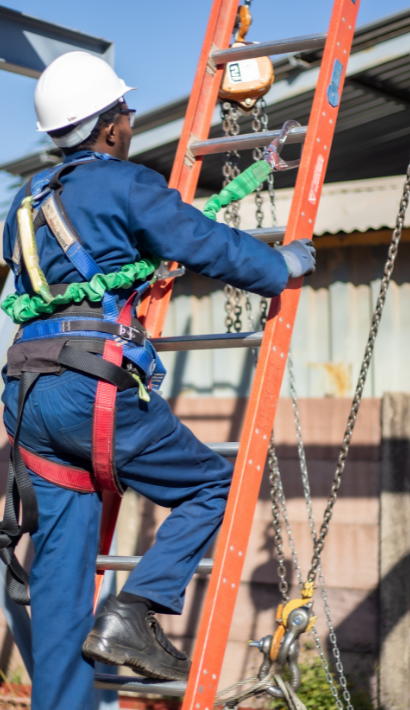
Lift Your Career to New Heights with the Rigger Trade at ATI
At ATI, we train future riggers to safely handle, secure, and move heavy loads that are essential to construction, mining, and industrial operations. Our hands-on, practical training equips you with the technical skills, safety knowledge, and precision required to excel in this critical trade.
From rigging cranes and hoists to ensuring safe load management, you’ll gain the expertise that keeps projects running smoothly and efficiently. At ATI, every lift you manage is a step toward a career built on skill, safety, and reliability.
Qualification purpose
A Rigger uses basic, intermediate, and advance lifting techniques to shift, lift, move, place and secure loads at
endpoints, without damage. The Rigger operates a variety of mechanical lifting equipment and supervises the
operations of lifting machines to perform lifting operations. In addition, the Rigger provides access to the work area by means of erecting and dismantling scaffolding that is maintained for use throughout the working period. A Rigger
also assembles fall prevention systems as a safe method of access to their working area and performs climbing
techniques safely. They work with a variety of fibre and steel wire ropes.
Foundational Learning Competence (SAQA Minimum Entry Level)
NQF Level 1 qualification with Mathematics.
Trade test requirements
Learner should have passed:
- N2 Mathematics, Engineering Science, Rigger Theory, Engineering Drawing
- N2 Certificate including the four relevant subjects of maths, engineering science and a fourth subject as
required by the trade: or
- Technical trade theory programs quality assured by a SETA deemed to be equivalent to NQF level 3 (N2);
or
- Relevant Engineering NCV Certificate with seven subjects at NQF level 3; or
- Technical Grade 11 with Maths, Science, Language, and related trade theory subject; or
- Relevant (directly related to the trade theory subjects) N6 certificate or National Technical Diploma (T, S
or N stream.)
In addition to the above-mentioned minimum educational qualification the applicant must also have:
- Successfully completed all off the job practical training unit standards (in the case of learnerships) or modules (in the case
of an apprenticeship) of an artisan learning program at an accredited training provider as verifiable by training records
(logbook).
- Satisfied the requirements of the structured workplace, on the job, learning for a minimum period of 12 months verifiable
through a workplace learning record (e.g. logbook) unless any other workplace period has been contractually specified before the date of publication of this Regulation.
Note: A Logbook is a record of all training the learner has received, contributing to their portfolio of evidence.
Skills obtained as outcomes
- Demonstrate the skills and ability to supervise the lifting, moving, and placing of complex loads by using
lifting machinery
- Demonstrate an ability to plan and schedule work.
- Apply procedures to solve a variety of problems within a mechanical handling context.
- Demonstrate leadership through effective interaction and communication with clients, peers, and
members of supervisory and management levels.
Qualification outcome
Qualified Rigger (red seal) Internationally Recognised
Types of jobs pertaining to the trade
- Entrepreneur / Contractor
- As an employee in any of the industries listed
Industries where they can work if qualified
- Manufacturing
- Mining
- Civil
- Agriculture
- Anywhere where rigging and slinging work needs to be done.
Approximate trade duration
Off the job practical training.
- Phase 1 – Duration – 12 Weeks
- Phase 2 – Duration – 12 Weeks
- Phase 3 – Duration – 8 Weeks
- Phase 4 – Duration – 4 Weeks (Revision and Trade Test)
Workplace (on the job) experience
- 18 months. Registered learner with a SETA.
- 3 years ARPL route.
Contact us now for more information at any of our nationwide branches.